The workplace wellness program ideas that actually get used are the ones built into the normal workday: healthy food in the breakroom, short bursts of movement, easy access to mental health support, schedules that respect sleep, and practical help with money. People use what is convenient. They skip what requires a new app, a lost lunch hour or a drive across town.
This guide covers ideas in each of those five areas, how to measure whether people are participating, and how to make the healthy choice the easy choice in your breakroom.
Do workplace wellness programs work?
Set expectations first, because the research is mixed. A RAND study of PepsiCo's program found that helping employees manage chronic illness saved $3.78 in health care costs for every $1 invested, while the lifestyle side of the program did not deliver returns higher than its costs. Lifestyle participants did report a small reduction in absenteeism.
A randomized trial at a large retail warehouse company landed in a similar place. After 18 months, Harvard Medical School reported that worksites offering the program had more employees exercising regularly and actively managing their weight, but no difference in clinical measures, health care spending or job performance.
The lesson is not to skip wellness. It is to treat it as a benefit and part of your culture rather than a quick fix for insurance costs, and to favor ideas that change daily habits.
Nutrition: make the healthy choice the easy choice in the breakroom
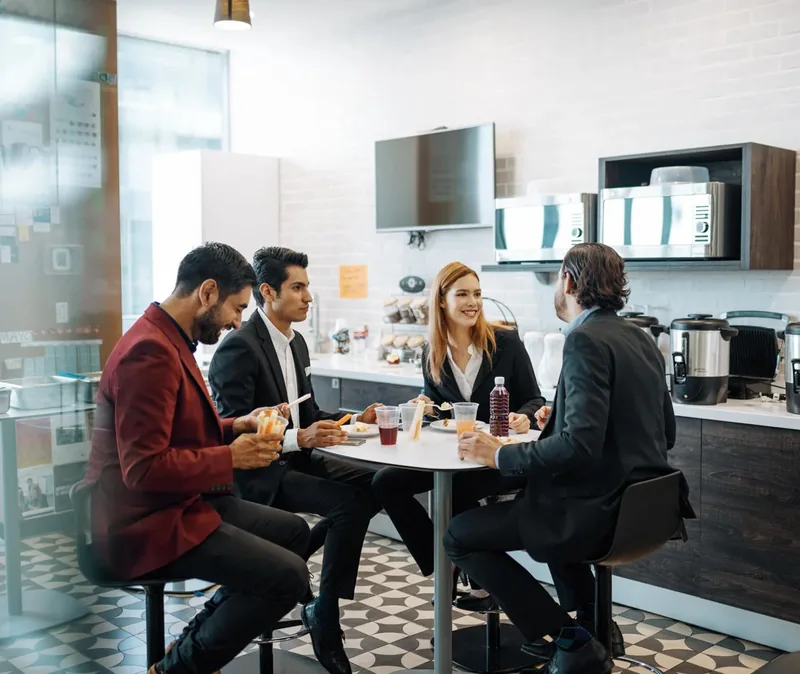
Nutrition is where the breakroom does the heavy lifting. Employees eat at work almost every day, so whatever is closest and fastest becomes the default. The CDC's food service guidelines set standards for healthier food and beverages in worksite settings, and they explicitly cover cafeterias, micro markets and vending machines. One of their stated goals is to change social norms so people expect healthier options to be available.
Ideas that work in practice:
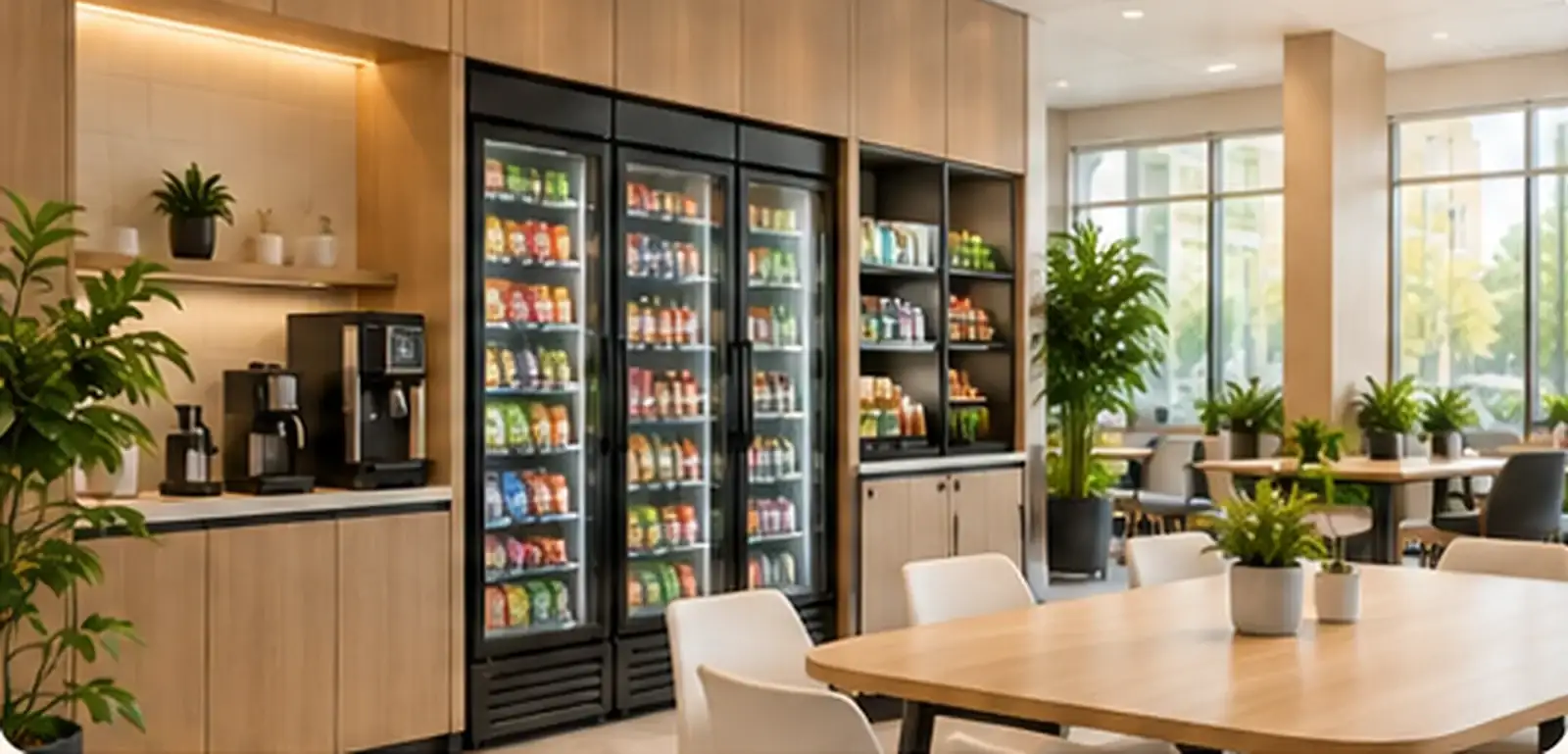
- Give better options the best real estate. In a micro market, put salads, fruit, yogurt and water in the most visible cooler space.
- Make the healthy item the cheaper item. A partial subsidy on fresh food tips the decision without a lecture.
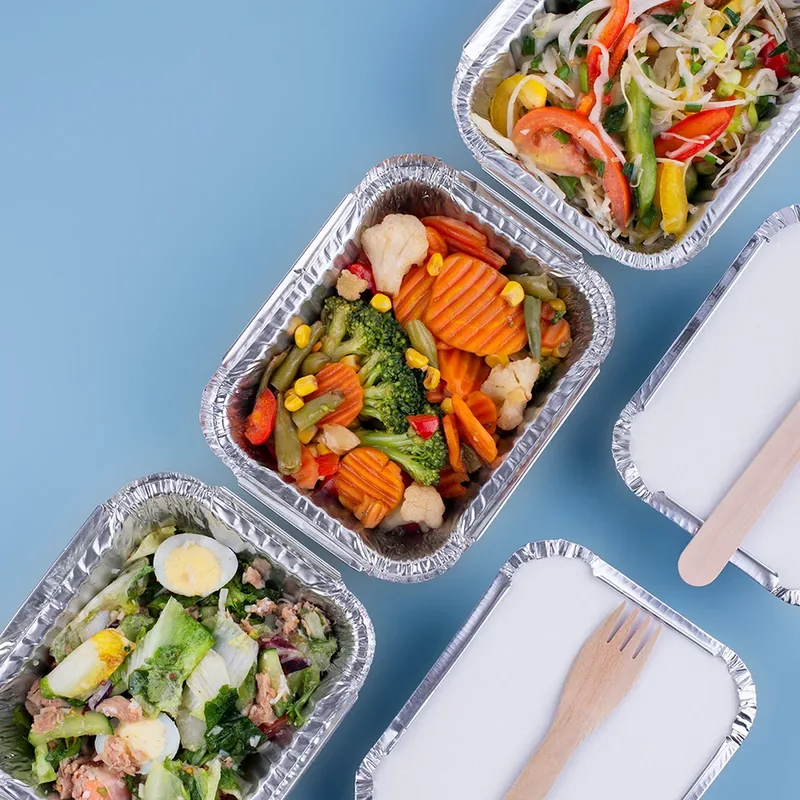
- Add real meals. Fresh chef-made meals give people an alternative to the fast food run at lunch.
- Upgrade the snack machine. Healthy vending keeps the convenience and changes what is inside.
- Let employees ask for what they want. With VendGO, staff scan a QR code to request items, and requests are filled within 3 days, so the healthy lineup matches real tastes.
The pattern behind all of these is the same. Make the better option the closest, cheapest and most visible one, and let the less healthy option take a little more effort. That is what the easy choice means in practice. For stocking ideas, see our guide to healthy office snacks.
Movement ideas that fit into a workday
The CDC's physical activity guidelines for adults call for 150 minutes of moderate-intensity activity a week plus at least 2 days of muscle-strengthening activity. The CDC also notes those minutes can be broken into smaller chunks, such as 30 minutes a day, 5 days a week. That is the opening for a workplace program: you do not need a gym, just room in the day.
- Walking meetings for one-on-ones and short check-ins.
- Team step challenges with small, frequent prizes instead of one grand prize.
- A 5-minute stretch at shift start for production and warehouse crews.
- Mapped indoor walking routes, because a lunchtime walk in an Atlanta July is a hard sell.
- Bike racks, showers or discounted gym access if you have the space or budget.
Keep it voluntary and low-pressure. Leaderboards that post individual weights or step counts can push away the people who would benefit most, so report team totals and celebrate showing up.
Mental health support employees will actually use
Most employers already offer something, often an employee assistance program (EAP), but it is easy for that benefit to get lost in a benefits packet. Support gets used when it is visible, private and normal to talk about.
- Post the EAP phone number in the breakroom and on the back of badges, not just in the handbook.
- Train managers to notice signs of stress and point people to resources.
- Allow time off for therapy appointments without a long explanation.
- Set aside a quiet room, even a small one, for a 10-minute reset.
- Keep workloads realistic. No app fixes chronic overwork.
Be honest about scope. A quiet room or a better breakroom will not replace professional care, but it can ease everyday stress and make it easier to reach for help when someone needs it. We go deeper on this in our article on employee mental health in the workplace.
Sleep: the wellness benefit most programs ignore
According to CDC FastStats on sleep health, 69.5 percent of U.S. adults got sufficient sleep in 2024. Put the other way, roughly 3 in 10 did not. Sleep affects mood, focus and safety on the job, yet it rarely shows up in a wellness plan.
- Set norms against late-night emails and after-hours messages that expect an answer.
- Give shift workers enough time between shifts and avoid quick turnarounds.
- Share practical guidance on meals and caffeine timing for overnight crews, like our night shift food ideas.
- Offer a sleep education session if your health plan or EAP provides one.
Financial wellness ideas
Money stress follows people to work. In the Federal Reserve's Economic Well-Being of U.S. Households in 2025 report, 63 percent of adults said they would cover a $400 emergency expense using cash or its equivalent. That means more than a third would not.
- Bring in a fee-free financial educator for budgeting or retirement sessions.
- Explain your 401(k) match in plain language, more than once a year.
- Offer payroll-based emergency savings if your provider supports it.
- Lower everyday costs. Subsidized breakroom food and free coffee save employees money every week.
How to measure wellness program participation
The CDC Workplace Health Model lays out four steps: assessment, planning and management, implementation, and evaluation. It describes a strong program as a coordinated set of programs, policies, benefits and environmental supports, not a single event. Do not leave evaluation for later. Decide what you will track before launch.
| Metric | How to calculate it | What it tells you |
|---|---|---|
| Reach | Unique participants divided by eligible employees | Whether the program reaches beyond the usual fans |
| Repeat participation | People who take part 3 or more times divided by all participants | Whether it became a habit or stayed a novelty |
| Reach by shift and site | Reach split by shift, location and department | Whether nights, weekends and remote staff are left out |
| Breakroom mix | Share of breakroom sales from healthier items | Whether daily food choices are actually changing |
| Employee feedback | A short pulse survey each quarter | What to drop, keep or expand |
Micro markets and smart coolers run on cashless platforms that record each sale, so ask your provider for the item mix before and after a change like a subsidy or a new fresh meal line.
Build a wellness-friendly breakroom with VendGO
VendGO is a locally owned breakroom company based in Alpharetta, serving corporate offices, plants and warehouses across metro Atlanta. We provide micro markets, AI smart coolers, healthy vending, office coffee and fresh meals with equipment, installation and service at $0 cost to your business, on month-to-month agreements. Employers can subsidize prices partly or fully, and you can see the full range of health and wellness breakroom options on our site.
Try it with a two-month trial and two dedicated account managers. Request a free consultation or call 678-848-5199 to talk with the owner directly.
Frequently asked questions
What are easy workplace wellness program ideas?
Start with ideas built into the workday: healthier breakroom food, walking meetings, a visible EAP, norms against late-night emails, and financial education sessions. Convenient ideas tend to get used far more than one-time events.
Do workplace wellness programs actually work?
They can change habits, but cost savings are often overstated. A randomized trial reported by Harvard Medical School found more regular exercise and weight management after 18 months but no change in clinical measures or health care spending, so treat wellness as a benefit, not a cost cutter.
How do you measure participation in a wellness program?
Track reach (unique participants divided by eligible employees), repeat participation, and reach by shift and site. Add a short quarterly pulse survey and, if you have a micro market, the share of sales from healthier items.
How can the breakroom support employee wellness?
Put healthier options in the most visible spots, add fresh meals, and use a subsidy so the healthy item costs less than the alternative. Letting employees request items keeps the healthy lineup matched to what people will actually eat.