
To reduce employee turnover in manufacturing and warehousing, focus on five things: the first 90 days, predictable schedules, breaks worth taking, real food on every shift, and frequent, specific recognition. None of them require a big budget. They require someone to own them.
Below is where turnover stands right now according to the Bureau of Labor Statistics, followed by the retention levers that matter most on a plant floor or in a distribution center.
What is the turnover rate in manufacturing and warehousing?
The Bureau of Labor Statistics measures quits and separations every month in its Job Openings and Labor Turnover Survey (JOLTS). JOLTS groups warehousing with transportation and utilities, so that is the closest published category for distribution centers. These are the seasonally adjusted rates for August 2026, the most recent month available (preliminary), from the BLS JOLTS release for August 2026:
| Industry | Quits rate | Total separations rate |
|---|---|---|
| Manufacturing | 1.6% | 2.5% |
| Nondurable goods manufacturing | 2.0% | 3.1% |
| Transportation, warehousing, and utilities | 1.9% | 3.5% |
| Total private | 2.1% | 3.5% |
Those are monthly rates, and they stack up. About 197,000 manufacturing workers quit in August 2026 alone, and the manufacturing quits rate was up from 1.3 percent a year earlier.
The full year tells the bigger story. According to the BLS table of annual average quits rates by industry, the monthly quits rate averaged 1.4 percent in manufacturing and 2.2 percent in transportation, warehousing, and utilities in 2025. Simple math puts that at roughly 17 and 26 quits per 100 jobs over the year, before counting layoffs or retirements. The BLS annual quits levels put it in people: about 2.1 million quits in manufacturing and 1.9 million in transportation, warehousing, and utilities in 2025.
Every one of those quits means another job posting, another orientation, and another new hire learning the equipment while the rest of the crew covers.
Why do plant and warehouse workers leave?
The reasons are rarely mysterious. The work is physical, shifts are long, and many sites run around the clock. In metro Atlanta, a picker or forklift operator can often find a similar job a few exits away in Gwinnett, south Fulton or along I-75, so small frustrations turn into resignations quickly.
Those frustrations tend to cluster: a confusing first week, a schedule that changes without warning, breaks too short to be useful, a breakroom with nothing worth eating on nights, and a supervisor who only speaks up when something goes wrong. Each one is fixable.
Fix the first 90 days with better onboarding
New hires decide quickly whether a job is worth keeping. Gallup reports that only 12% of U.S. employees say their company does a good job of onboarding, and that when the manager takes an active role, employees are 3.4 times as likely to feel their onboarding was successful.
On a plant floor or in a warehouse, good onboarding looks like this:
- Pair every new hire with a named trainer for the first two weeks, on their actual shift.
- Give a real site tour on day one, including where to park, clock in, eat and take breaks.
- Have the direct supervisor check in on day 1, at week 1, at day 30 and at day 90.
- Track 90-day turnover separately from overall turnover, by shift and by supervisor.
Skipping this gets expensive fast. A new hire who quits in week three takes the recruiting spend, the safety training and the trainer's time with them, and the open spot lands back on the crew as overtime.
Make schedules predictable
Unpredictable hours push people out. Research from the Shift Project at Harvard Kennedy School, which followed hourly retail and food service workers, found that exposure to schedule instability was a strong, robust predictor of turnover. Plants and warehouses are not retail, but the lesson carries over: hourly workers need hours they can plan a life around.
- Post schedules at least two weeks out and keep shift start times consistent.
- Limit mandatory overtime announced at the end of a shift.
- Offer a simple, approved process for shift swaps.
- Share peak season overtime plans early so people can arrange childcare and rides.
Protect breaks and make them worth taking
Breaks are a retention tool hiding in plain sight. According to the U.S. Department of Labor, federal law does not require lunch or coffee breaks, but when employers offer short breaks (usually about 5 to 20 minutes), that time counts as paid work hours. Bona fide meal periods, typically at least 30 minutes, are not paid.
If you are paying for a 15-minute break, make sure it is actually restful. That means a breakroom close to the floor, enough seating for the whole crew, climate control (an Atlanta loading dock in August is no place to eat lunch), and food and cold drinks that do not require a walk across the building. Our break room ideas guide covers upgrades that hold up in industrial settings.
Put real food within reach on every shift
Day shift often has a cafeteria, a food truck or a lunch run. Second and third shift usually get a snack machine. That gap tells night workers exactly where they rank.
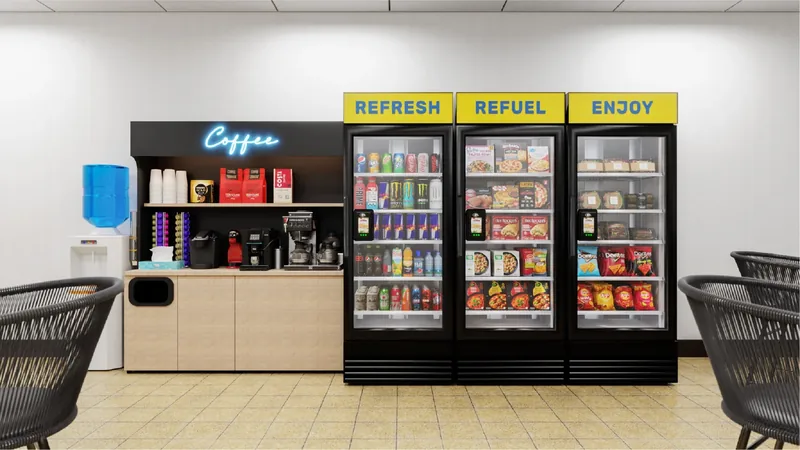
A micro market or an AI smart cooler closes it. Both can offer fresh meals, salads, sandwiches, snacks and drinks with cashless self-checkout, so the 2 a.m. crew gets the same options as the 10 a.m. crew. Employers can go further with subsidized vending and markets, covering part or all of the price, which turns the breakroom into a perk people notice every shift. For what overnight crews should actually eat, see our guide to night shift food ideas.
VendGO sets up breakrooms for manufacturing facilities and warehousing operations across metro Atlanta, sizing each micro market to the headcount on site.
Placement matters as much as selection. Put the market or cooler where every shift passes it, near the time clock or the main break area, so a 15-minute break is enough to grab a meal and actually sit down.
Recognize good work often and specifically
Recognition costs little and pays back in retention. In research Gallup conducted with Workhuman that tracked nearly 3,500 employees from 2022 to 2024, well-recognized employees were 45% less likely to have changed organizations two years later. Yet only 22% of U.S. employees say they get the right amount of recognition.
- Call out safety catches, quality saves and attendance streaks by name at shift huddles.
- Make sure night shift supervisors recognize their people as often as day shift does.
- Tie small rewards to real milestones, like 90 days, one year and the end of peak season.
- Bring the celebration to the shift. A catered meal at 2 a.m. lands better than a 2 p.m. party nobody on nights can attend.
For more ideas that work on a budget, see our list of employee appreciation ideas.
Build a breakroom that helps you keep people
VendGO is a locally owned breakroom company based in Alpharetta that provides micro markets, AI smart coolers, vending and fresh meals across metro Atlanta. Equipment, installation and service cost your business $0, agreements are month-to-month with no long-term contract, and every account gets two dedicated account managers and a two-hour response time when something needs attention. Employees can scan a QR code to request products, and requests are filled within 3 days.
Start with a two-month trial and watch how your crews respond. Request a free consultation or call 678-848-5199 to talk with the owner directly.
Frequently asked questions
What is the average turnover rate in manufacturing?
BLS data shows the manufacturing quits rate averaged 1.4 percent a month in 2025, roughly 17 quits per 100 jobs over the year, and it was 1.6 percent in August 2026. Total separations, which also count layoffs and other exits, were 2.5 percent that month.
Why is turnover so high in warehouses?
Warehouse work is physical, often runs around the clock, and similar jobs are usually easy to find nearby, so poor onboarding, unpredictable schedules and weak break conditions push people out quickly. BLS groups warehousing with transportation and utilities, where quits averaged 2.2 percent a month in 2025.
What is the fastest way to reduce turnover in a warehouse?
Start with the first 90 days: assign a trainer, have supervisors check in on a set schedule, and track early turnover by shift. Then fix schedule predictability and break conditions, which affect everyone on the floor.
Do breakroom perks really help retention?
They help most when they solve a daily problem, like having no real food on the night shift. A micro market or smart cooler with fresh meals, especially with a subsidy, is a benefit employees use every shift instead of once a year.