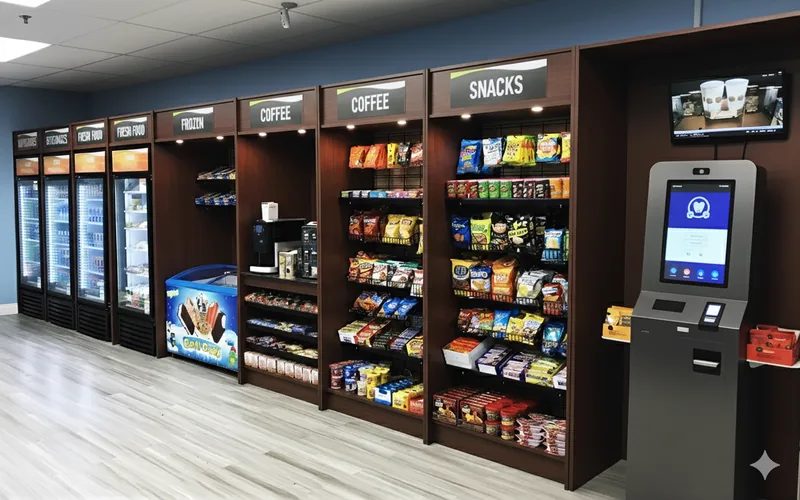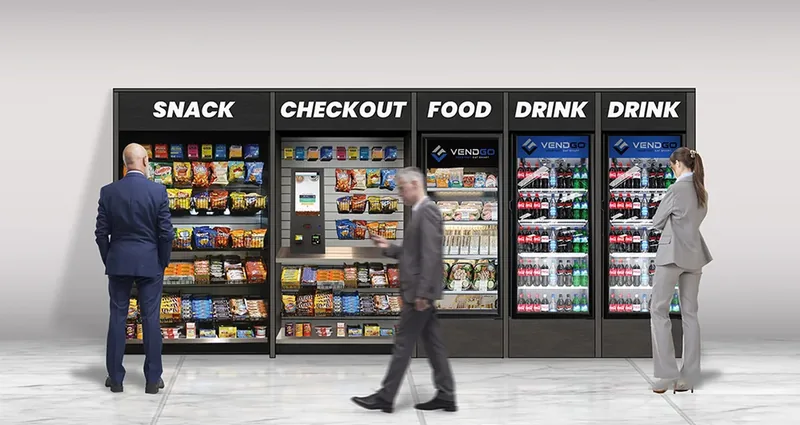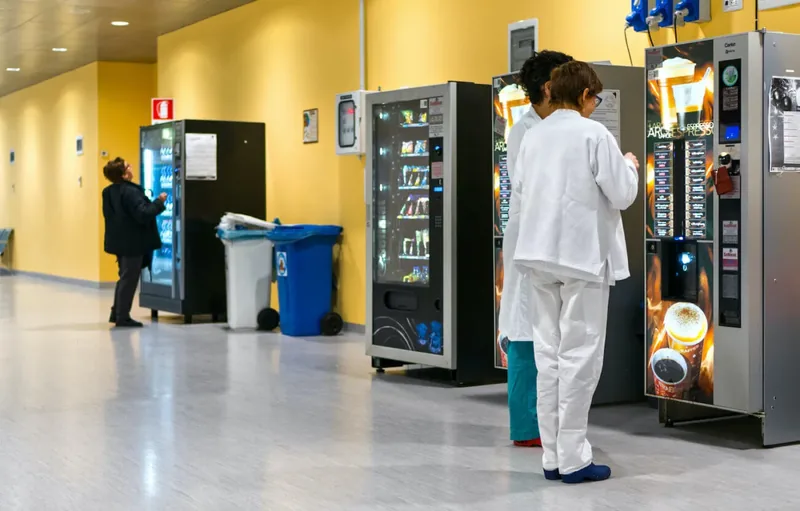
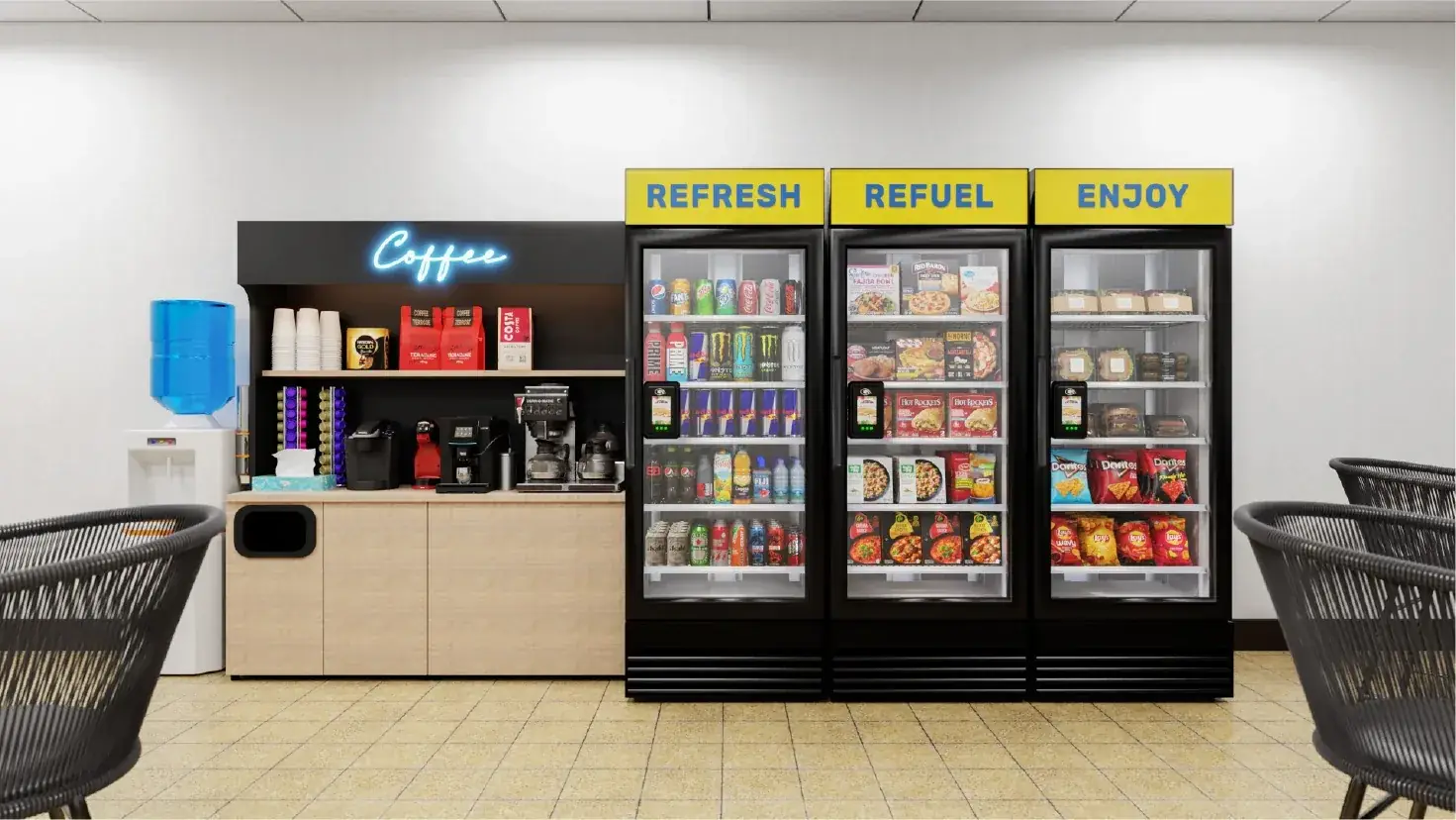
A vending machine is a locked cabinet that sells a few dozen packaged snacks or drinks, one coil at a time. A micro market is a small self-checkout store: open shelves, glass-door coolers and a kiosk where employees scan and pay. If you have the floor space and a steady group of employees, a micro market almost always offers more choice and better food.
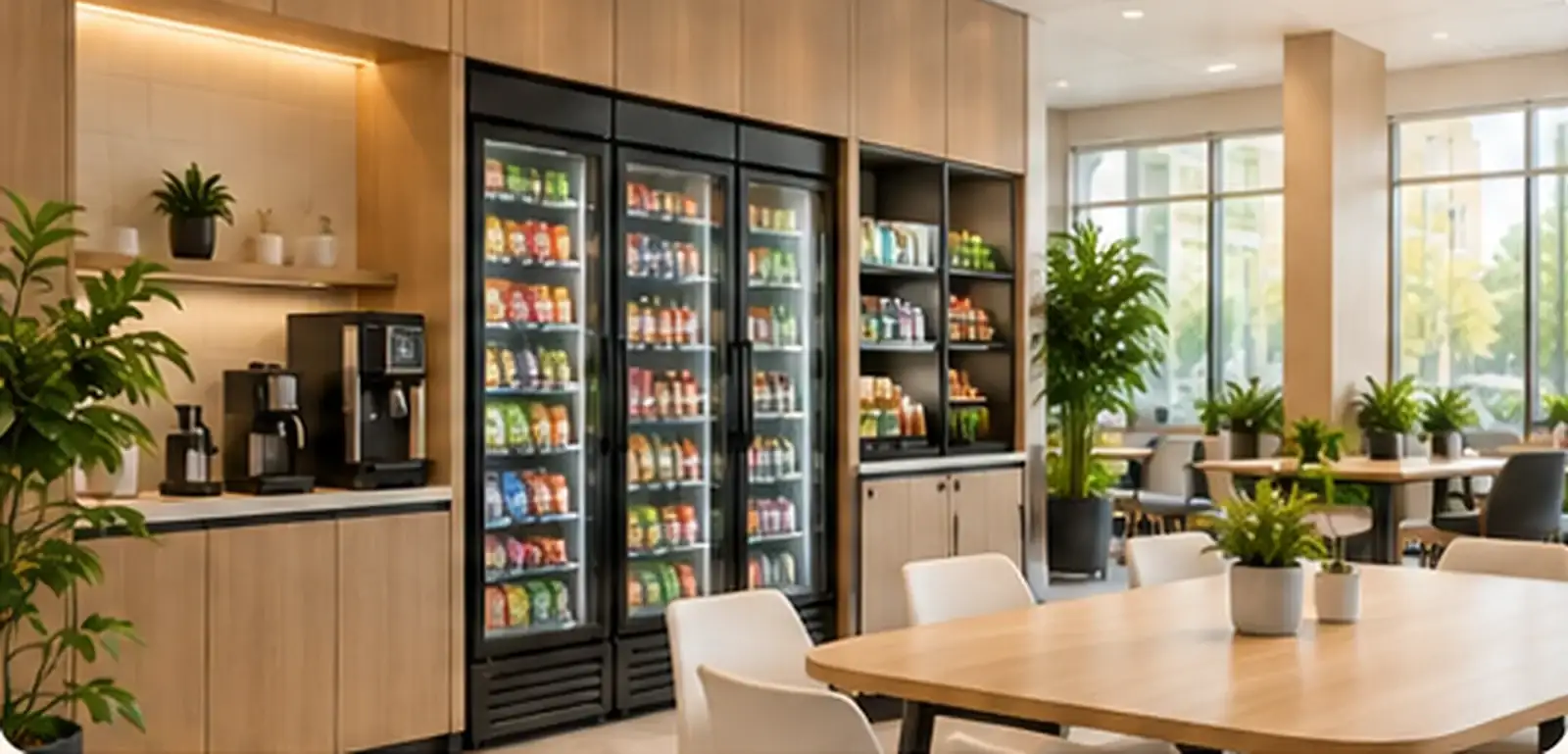
Vending still earns its place where space is tight, the area is open to the public, or a lot of people pay in cash. And there is a middle option, the AI smart cooler, which carries fresh food like a market but stays locked like a machine. Here is a straight comparison of all three.
What is the difference between a micro market and a vending machine?
The National Automatic Merchandising Association describes micro markets as unattended retail spaces where people handle products on shelves and in open coolers, then pay at a self-checkout kiosk with a cashless payment system. Nobody staffs the register. The kiosk, the cameras and the honor system do that job.
A traditional vending machine works the other way around. You pick a slot, pay, and a spiral coil pushes one item into the bin. Every product stays behind glass until it is paid for, which is why vending is simple, compact and very hard to steal from.
Micro market vs vending machine at a glance
| Factor | Vending machine | AI smart cooler | Micro market |
|---|---|---|---|
| Selection | A few dozen packaged items | One cooler of grab-and-go items | The widest range: shelves, coolers and freezers |
| Fresh food | Limited, and only in refrigerated food machines | Yes: salads, sandwiches, meals, fruit | Yes, with room for frozen and larger meals |
| How people pay | Card or phone, and many machines take cash | Tap a card or phone to unlock, charged automatically | Scan items at a cashless kiosk |
| Space needed | A stretch of wall and an outlet per machine | About the footprint of one commercial fridge | A dedicated corner or small room |
| Theft and shrink | Very low, since product is locked | Very low, since the door unlocks only for a card | Higher, managed with cameras, layout and culture |
| Best fit | Small crews, hallways, cash-heavy teams | Public-facing or mixed-access spaces | Offices, plants and warehouses with a breakroom |
Selection and fresh food: where micro markets pull ahead
A coil can only hold items of a certain size and shape, so a snack machine tops out at chips, candy, pastries and a few protein bars. Refrigerated food machines exist, but they still limit what fits in a slot. In a micro market, a salad, a large yogurt, a piece of whole fruit and a microwave meal all sit side by side on open shelves.
That matters for more than variety. People make better choices when they can see real food. With a market or a cooler, you can stock fresh, chef-made meals instead of hoping everyone packed a lunch. Shoppers can also pick up a package and read the whole label. The FDA's vending machine labeling rule requires operators with 20 or more machines to disclose calories, but nobody can flip a package over to check ingredients through vending glass.
Whichever you choose, the product mix should not be fixed forever. At VendGO, employees scan a QR code to request products, and requests are filled within 3 days.
Payments: cards, phones and the cash question
Most breakroom buyers have moved past cash. In the Federal Reserve's 2026 Diary of Consumer Payment Choice, debit and credit cards made up two-thirds of all consumer payments. Pew Research Center found that 42% of U.S. adults use no cash at all in a typical week, rising to 51% of adults under 30.
The same Pew survey carries a fair warning, though. About 26% of adults in households earning under $30,000 still use cash for all or almost all of their purchases. Micro markets and smart coolers are cashless by design, so if a large share of your team pays in bills, keep that in mind before you pull out every coin-operated option.
VendGO runs cashless payments, cards and mobile wallets, through established platforms including Cantaloupe, 365 Retail Markets, Nayax and HAHA smart coolers. Tap-to-pay keeps lines short at shift change, which is when most breakrooms get slammed.
Space, power and placement
A vending machine needs a stretch of wall, an outlet and room for the door to swing open during service. Two or three machines in a row fit in a hallway alcove. That compact footprint is vending's biggest advantage.
A micro market needs a real footprint: a corner of the breakroom or a small room with space for coolers, shelving and the kiosk, plus clear walking paths. The size scales with your team. VendGO plans markets in headcount tiers of 25 to 75, 75 to 150, 150 to 250, 250 to 350, and 350+ employees, so a 60-person office and a 400-person plant get very different layouts.
Placement is the other half of the decision. A micro market belongs in an employee-only area. If the space is open to visitors, customers or the public, a locked option makes more sense.
Theft and shrink: the trade-off of an open store
This is the honest downside of a micro market. When products sit on open shelves, some will leave without being scanned. Vending has almost no shrink because nothing comes out until it is paid for.
Well-run markets keep losses manageable with visible cameras, a kiosk placed on the way out, smart product placement and a workplace culture where paying is normal. We cover the specifics in our guide to micro market theft prevention. For most employee-only breakrooms, the extra selection is worth the trade.
Where do AI smart coolers fit?
An AI smart cooler is the in-between option. The door stays locked until someone taps a card or phone. They open it, grab what they want, close it, and cameras and sensors charge them automatically for what they took.
You get fresh food, drinks and snacks like a small market, with the security of a machine. That makes smart coolers a strong fit for lobbies, showrooms, gyms, apartment amenity spaces and any site where non-employees pass through. At VendGO, the choice between a micro market and a smart cooler comes down to your preference and the type of business, not headcount.
Which option fits your workplace?
- Corporate offices with a breakroom: a micro market usually wins, with more choice, fresh lunch options and a space that feels like an amenity.
- Manufacturing plants and warehouses: a market or smart cooler with fresh meals carries second and third shifts when nothing nearby is open. The Bureau of Labor Statistics reports that 15% of wage and salary workers usually work a non-daytime schedule, and 25% in transportation and utilities. Our page on manufacturing facilities has more on serving plant crews.
- Public-facing or mixed-access sites: a smart cooler, because it stays locked.
- Small crews, tight hallways or cash-heavy teams: a vending machine or two still makes sense.
In metro Atlanta, where a lunch run can eat half a break in traffic, on-site food people actually want is a real perk. If you are still torn, the Help Me Choose quiz asks a few quick questions and recommends a setup for your site.
Try a micro market or smart cooler with VendGO at no cost
VendGO is a locally owned breakroom company based in Alpharetta, and you talk to the owner, not a call center. Equipment, installation and service cost your business $0, with month-to-month agreements and a two-month trial, so you can test a setup without a long-term contract. If you are wondering what a company-owned market would cost instead, see how much a micro market costs.
Ready to compare options for your space? Request a free consultation or call 678-848-5199.
Frequently asked questions
Is a micro market better than a vending machine?
For most employee-only breakrooms with a steady headcount, yes, because a micro market offers far more choice and fresh food. Vending is still the better fit for very small crews, tight spaces, public areas and teams that rely on cash.
Do micro markets have more theft than vending machines?
Yes. Open shelves mean some shrink, while vending keeps every item locked until it is paid for. Visible cameras, kiosk placement and employee-only locations keep micro market losses manageable.
How much space does a micro market need?
It depends on headcount. A small office can run a market in a breakroom corner, while a large site needs a dedicated room with several coolers, shelving and a kiosk. If space is tight, an AI smart cooler takes about the footprint of one commercial fridge.
What is the difference between a micro market and an AI smart cooler?
A micro market is an open store with shelves, coolers and a self-checkout kiosk. An AI smart cooler stays locked until someone taps a card, then cameras and sensors charge for whatever they take, which suits public or mixed-access spaces.